In an industrial market that continues to grow rapidly, Reeves Young Industrial empowers its clients by providing a fully integrated team of construction professionals with self-perform capabilities and the technical expertise to deliver projects quickly, safely, and with quality to meet ever-increasing market demand.
For Mckenna Rodgers, finding her place in construction has been shaped by experience, relationships, and a strong understanding of the work.
At 5’1″, Rodgers is often the smallest person on the jobsite. It’s something people notice right away, but it has never defined her ability to lead. “I’ve even been jokingly called an ‘ankle biter,’” Rodgers says. “It’s always funny to see the initial surprise, but moments like that have taught me that presence isn’t about height.”
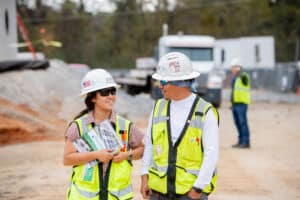
Mckenna and construction crew working on Hyatt Centric project in Atlanta
From early on, she was immersed in the industry through her father’s residential general contracting business. Spending time on jobsites gave her a firsthand look at how projects come together, from field operations to project management.
“He owns his own company, and growing up I was always visiting his jobsites,” she says. “I had a front-row seat to both the field operations and the behind-the-scenes management.” Those early experiences built a foundation she still relies on today, giving her a practical understanding of schedules, budgets, coordination, and problem-solving.
As she transitioned into commercial construction, Rodgers quickly realized that technical knowledge was only part of the equation.
“Construction is truly a ‘people’ business,” she says. “It’s not just about drawings, schedules and budgets. It’s about relationships.”
Developing the ability to navigate different personalities, communicate clearly, and build trust became one of her biggest areas of growth, as well as a key factor in her effectiveness on the job.
“I was leading a coordination meeting and fielding questions from multiple trades, the design team, and ownership,” she recalls. “And I realized I wasn’t second-guessing myself anymore.” Moments like that reinforced her confidence in leading and supporting her team.
During Women in Construction Week, Rodgers’ experience reflects a broader industry reality where opportunities are growing, even as construction remains largely male-dominated. “Let it roll off your back,” Rodgers says. “You have to have thick skin.”
At the same time, she emphasizes that preparation is what creates confidence. “Knowledge is power. Do your research, know your scope, and understand the details,” she says. “When you’re prepared and confident in your knowledge, you can’t be pushed around.” For Rodgers, that mindset has shaped how she approaches her work and how she hopes to support others entering the field.
Looking ahead, one of the things she’s most excited about is the opportunity to mentor other women in construction. “Being able to share my experiences and help make it a little smoother for the next generation,” she says.
She understands the value of having strong teams and reliable support systems—something that continues to motivate her day to day. “The field teams I work with,” she says. “When you have a strong team that supports each other and can joke around a bit, it’s easier to push through tough days.” And when those projects come to life, the reward is clear.
“Seeing something that started as drawings on paper come to life is incredibly rewarding,” Rodgers says.
Women in Construction Month is not just about recognition; it’s about representation, growth, and women driving the industry forward.
For Mckenna, that place is defined not by stature, but by presence, preparation, the teams she builds, and the impact she continues to make.
We sat down with Reeves Young’s Director of Industrial Business Development, Brenttnie Smith, to talk about her career, what paved her way into construction, and what success looks like to her.
Can you tell me about your path into construction and what ultimately led you into business development?
My path into construction was not traditional at all. I came from a sports broadcasting background, which on the surface had nothing to do with construction. Early in my career, I was focused on storytelling, relationship-building, live production, and communicating clearly under pressure.
When I moved to Atlanta in 2017, I was introduced to the AEC industry and, more specifically, to the role of business development. I quickly realized how transferable my skill set was. Sports broadcasting taught me how to connect with people quickly, ask thoughtful questions, listen actively, and communicate a message in a compelling way. It also required preparation, research, and the ability to think on my feet — all of which are critical in business development.
In construction business development, success is rooted in relationships, strategic communication, and understanding your audience. My background helped me become comfortable in front of clients, navigate high-pressure situations, and represent my company with confidence and clarity. What started as an unexpected career pivot ultimately became a natural fit, allowing me to blend relationship-building and storytelling with strategy and growth in the construction industry.
Business development requires both technical understanding and strong relationships. How have you learned to balance those two skill sets?
That balance has been intentional for me.
Coming into the industry from a non-technical background, I knew early on that if I wanted to be effective in business development, I would have to make a conscious effort to immerse myself in all aspects of construction — spending time with our operations teams, asking a lot of questions in preconstruction meetings, learning how projects are estimated and executed, and really understanding the nuances of industrial work.
At the same time, I’ve leaned into what I naturally bring to the table — building authentic relationships. Strong relationships open doors, but technical understanding builds credibility. I never want to be the person in the room who can connect well but can’t speak intelligently about what our team executes. So, I prepare by leaning in and listening to the expertise of my teammates.
Brenttnie Smith and the rest of the NAIOP Future Leaders class of 2026.
Was there a moment in your career when you realized you had found your stride as a leader?
I would say that moment has really happened over the past two years.
I naturally stepped into mentoring young professionals who were exploring or just starting their careers in business development. At first, it happened informally — answering questions, pulling them into meetings, helping them think through strategy or navigate client conversations. But over time, I realized they weren’t just asking for advice — they were looking to me for guidance.
Being able to serve as a resource, create opportunities for them, and help facilitate their growth has been incredibly meaningful. Watching them connect the dots, build relationships, and step into their own leadership has honestly been one of the most rewarding parts of my career.
That’s when I knew I had found my stride — not just in doing the work, but in helping shape the next generation of business development professionals.
As a woman in a highly relationship-driven and often male-dominated industry, have you ever had to approach situations differently to build credibility or trust?
If I’m being honest — yes. And I hate to say that, but it’s true.
I’ve been incredibly fortunate to earn a great deal of respect from my counterparts and many clients, and I’m truly grateful for that. But in a highly relationship-driven and often male-dominated industry, there have absolutely been moments where I’ve felt like I had to work twice as hard to prove my worth.
There are times I’ve felt the need to show up twice as much, be twice as prepared, be twice as quick with answers, and sometimes even twice as loud to ensure my voice is heard and my value is recognized. Not in a negative or resentful way — but in a very real, aware way.
What that experience has done, though, is sharpen me. It’s made me more prepared, more technically fluent, more confident in rooms where I may be the only woman at the table. Over time, credibility compounds. Consistency builds trust. And once that trust is established, it becomes less about proving yourself and more about delivering results.
What does strong leadership look like to you today?
To me, strong leadership today is about leaving your ego at the door.
It’s about putting the team above yourself — prioritizing collective success over personal recognition. A strong leader doesn’t need to be the loudest voice in the room or the one getting the credit. They focus on creating clarity, alignment, and opportunity for others to succeed.
It’s also about emotional discipline. Whatever is happening in your personal life — stress, frustration, challenges — you must have the maturity to leave that at the door when you step into the office. Your team deserves consistency. They deserve steadiness. Leadership means managing your emotions, so they don’t manage the room.
Strong leadership, to me, is steady, self-aware, and service-oriented. It’s about creating an environment where people feel supported, focused, and motivated.
What part of your role do you find most energizing or rewarding?
What I find most energizing and rewarding is watching our team win.
There is nothing better than seeing their faces light up when we land a deal that once felt out of reach — the ones we talked about strategically, chased intentionally, and maybe even thought were a long shot. Watching something that started as a vision turn into a signed contract is incredibly fulfilling.
It’s also rewarding to see us win awards or recognition that we weren’t even considered for before. That growth — from being overlooked to being a serious contender — represents the work, the grit, and the belief our team has built together.
For me, the real reward isn’t just the win itself. It’s the confidence that grows in the team because of it. It’s watching people realize what they’re capable of. That momentum, that shared pride — that’s what energizes me the most.
Brenttnie Smith and Chris Smith accepting the 2024 CMAA Project Achievement Award for Industrial New Construction Value More than $50 Million for the Falcon Parkway Industrial Park Campus on behalf of the Industrial team.
How has your perspective on success evolved over time?
Earlier in my career, I probably would have defined success by titles, recognition, or financial milestones. And while those things aren’t unimportant, my perspective has shifted significantly over time.
Today, success isn’t about money or titles anymore. Success is time.
It’s having built something strong enough — relationships, reputation, results — that I’m trusted. That I’m not forgotten or passed over because I choose to manage my time intentionally between work and home. It’s knowing I’ve done such a good job delivering value that I can step away for my family when needed without everything unraveling.
Success, to me, is being present. It’s getting to take time with my family without guilt, because I’ve put in the work and built a foundation that speaks for itself. That balance — and the freedom that comes with it — means far more to me now than any title ever could.
What advice would you give to young women who are interested in entering construction or business development but aren’t sure where they fit?
My biggest advice would be to reach out and find a mentor.
This industry can feel overwhelming from the outside, especially if you’re not sure where you fit. But there is so much opportunity within construction and business development — operations, strategy, marketing, estimating, client relations — that you don’t have to have it all figured out on day one.
Find someone who’s a few steps ahead of you and ask questions. Learn from their experiences — both their wins and their mistakes. Borrow their perspective. Let them help you navigate rooms, conversations, and career decisions with more confidence. A good mentor can shorten your learning curve dramatically and help you see potential in yourself that you might not recognize yet.
Brenttnie and a colleague taking a photo together at the NAIOP Georgia Night at the Fights event.
Outside of your title and responsibilities, what is something people may not know about you that has shaped who you are professionally?
Two things have shaped me professionally in ways people may not immediately see.
First, I have an amazing family at home and that includes my son, Oliver, who has completely changed my world for the better. Becoming a mother has given me a different lens on leadership, priorities, and perspective. It’s made me more efficient, more present, and more intentional with my time. Motherhood has strengthened me in ways I didn’t anticipate, and that absolutely shows up in how I lead and how I build relationships.
Second, I lost my father in 2016 to brain cancer. That experience will never leave me — and in many ways, I don’t want it to. It reshaped how I view work, pressure, and what truly matters. It gave me a profound sense of empathy and a reminder that we’re all carrying something unseen. It also grounded me in the understanding that we’re not just working for titles or accolades — we’re working for something bigger, for our families, for stability, for impact.
Both motherhood and loss have refined my perspective. They’ve made me more compassionate, more driven, and more aware that success means very little if it isn’t anchored in purpose and people.
What’s a moment in your career that made you think, “I can’t believe I get to do this”?
The moments that stand out most are when I step back and realize where this career has taken me.
I get to travel to some incredible places around the country — cities and facilities I once only imagined visiting. Walking job sites, touring operations, sitting in boardrooms in places I used to just read about… there are moments where I genuinely pause and think, “I can’t believe this is part of my job.”
I also get to meet executives and CEOs of companies I previously only knew from industry articles or press releases. Sitting across the table from leaders of major organizations, having strategic conversations, and representing my team in those rooms is something I don’t take lightly. It’s both humbling and energizing.
What’s one lesson construction has taught you that applies far beyond work?
One lesson construction has taught me that applies far beyond work is that foundations matter — in everything.
In construction, if the foundation isn’t solid, nothing else works. You can have the most beautiful design, the best finishes, the strongest team — but if the groundwork isn’t right, cracks eventually show.
That principle applies to relationships, leadership, and life. The way you build trust, the way you communicate, the way you show up consistently — those are your foundations. You can’t shortcut them. You can’t rush them.
Construction has reinforced for me that what’s below the surface is often more important than what’s visible. Character, integrity, preparation, and resilience — those are the true foundations. And when those are strong, everything else has something solid to stand on.
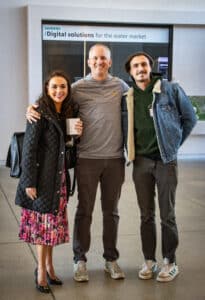
Brenttnie Smith, Stephen McMillan, and Will Poland at the Reeves Young February 2026 Staff Meeting.
If you could go back and give your younger self one piece of advice at the start of your career, what would it be?
If I could go back and give my younger self one piece of advice, it would be this: never allow your own light to be dimmed.
You worked hard to get where you are. Don’t let anyone minimize that. Don’t shrink yourself to make others more comfortable. Don’t question whether you belong in certain rooms.
You are in the rooms you’re in because you earned the spot to be there.
There will be moments early in your career where you may feel intimidated, underestimated, or unsure. But confidence doesn’t mean arrogance — it means recognizing your preparation, your work ethic, and your value. Own that.
I would tell my younger self to stand tall, speak up, and trust that she’s exactly where she’s supposed to be — not by accident, but by hard work.
Brenttnie at the Reeves Young February 2026 Staff Meeting
For Marcela Restrepo, construction has always been about more than schedules and structures. It’s about people, communities, and the stories that unfold through every project.
Her journey into construction began on a high school trip to Princeton University, where she discovered her passion for urban planning and building. Today, Restrepo serves as a Senior Project Manager with Reeves Young’s Commercial Construction team in Nashville, leading complex projects while mentoring the next generation of construction professionals.
Marcela Restrepo, a Colombia native, came to the United States as a high school exchange student. During a field trip to Princeton University, she had the chance to explore urban planning and building through the simulation game SimCity. That moment sparked the beginning of the rest of her career. From that day forward, she knew she would become a civil engineer.
Like all careers, hers is not free of trials and tribulations. However, she has loved it all, even through its ups and downs. Restrepo says, “What keeps me here is that there is a tangible result, and as hard and demanding as it can be, every project is its own story in and of itself, and every one of those stories is another chapter in my life story.”
She explains, “All the challenges, long days, relationships and exciting moments make it all worthwhile, and it is a wonderful feeling to be part of a project from start to finish.”
When Restrepo started her career in New York City, she was the youngest person on the projects and the only woman. In “the place where ‘if you can make it here, you can make it anywhere,’” she knew no one would just hand it to her.
To make her mark on the city, she knew she had to be more prepared, more committed, and more involved than her peers. She says, “I always took the time to meet everyone on the projects and listen to all the stories and experiences that they wanted to share.” Those relationships became the foundation of her leadership style.
Over the years, Restrepo adopted being a mentor as a part of her career. Mentorship became something meaningful and important to her. “I have taken many young people under my wing, and they have moved up to become successful project managers,” she says. “I have watched their careers take off and most of them are life friends outside of work.”
Even today, Restrepo still receives calls from former mentees sharing updates about their careers and successes. Her mentorship style focuses on helping young professionals build confidence in the industry. Rather than leaving people to figure things out on their own, she walks them through processes step by step so they understand what matters most and why. She also emphasizes the importance of building strong personal relationships on the jobsite so team members feel comfortable asking questions.
“You are a leader when you keep your team informed, set expectations, and hold them accountable,” Restrepo explains. “And you do this with a positive attitude and the goal of empowering them to succeed.” She believes a great project manager must be detail-oriented, organized, fair, honest, and knowledgeable. But true leadership requires something more.
“A great leader is also approachable and personable,” she says. “They connect with their team and treat trade partners and colleagues with respect.”
Marcela taking a photo with Reeves Young coworkers at the Reeves Young Nashville Holiday Party
The defining moment in Restrepo’s career was when she looked around the project staff meeting of the Bronx Point and home of the Universal Hip Hop Museum project in New York City only to realize that she was the leader of the room. She was no longer the young woman learning the ropes; she was now the expert. “I realized I was the adult in the room,” she recalls. “I had the experience, the years in the industry, and the answers.” It was then that she realized that she, alone, had the capability and responsibility to take these young people and craft them into construction professionals.
Throughout her more than 20 years in construction, Restrepo has seen the industry evolve—especially in the growing presence of women in the field. In 2006, women made up just over 8% of the construction workforce (Zhao, 2025). In 2025, that number has risen to 11.3%, an increase of 3.3 percentage points (U.S. Bureau of Labor Statistics, 2025). Still, representation in leadership remains limited. As of 2025, women hold only 18% of leadership positions in the industry.
“There is still a long way to go,” Restrepo says. “But when I started my career, I was the only woman on the projects.”
By the time she left New York City, that had changed dramatically. “I was on a project where the only male in the Owner, Architect, Contractor meetings was the superintendent,” she says.
Much of Restrepo’s career has been dedicated to affordable housing projects, work she finds especially meaningful. “I always felt a profound sense of accomplishment giving back to the community,” she says.
Today, she continues that passion through involvement with Nashville’s Young Leaders Council program, which focuses on affordable housing initiatives. She hopes to one day serve on the organization’s board of directors.
Outside of work, Restrepo enjoys spending time outdoors, sharing laughs with friends and family, and going on date nights with her husband Peter, who she proudly describes as a phenomenal chef.
Do It Scared: Building Confidence in Water Resources Construction with Monica Pineda
Water is something most people never think about, of course, until it stops flowing. Behind every sip, wash, and flush, is a complex system of plants, pipelines, and people working around the clock to keep communities running. For Reeves Young Water Resources Project Manager Monica Pineda, that invisible work is both a responsibility and a calling.
Pineda is working on a critical water infrastructure project in Braselton, Georgia, which impacts residents and business owners alike. “Construction still gets a bad reputation,” she says, “but there’s a tremendous amount of skill and planning behind every project. No one sees the crews working through the night to keep these systems operational, but that’s what keeps everything flowing.” She continues, “We can’t just shut down a plant and start over. We have to build around it while it’s running. Every water plant is different. Every system is unique. There’s nothing simple about it.”
When asked what she wishes people understood about water infrastructure, Pineda explained, “Your water infrastructure affects anything from your mom-and-pop shop down the road to the water in your home. Whether it’s going into a wastewater plant or a water plant, it has to go somewhere, right? It impacts your everyday life, from the moment you get out in the morning until the moment you go to bed. Every single day.”
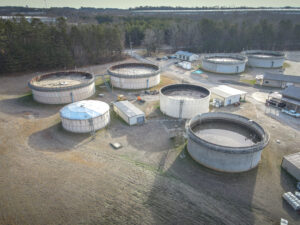
This photo was taken in January 2024 before construction had begun.
Maintaining public health in the U.S. requires a massive logistical effort. The ASCE reports that there are 2.2 million miles of piping buried beneath our feet to provide fresh water. This system is supported by over 16,000 specialized plants responsible for cleaning and recycling wastewater before it returns to the environment. Pineda emphasizes, “These projects are the reason you have clean tap water.” She continues, “Just think about your health, right? It’s preventing waterborne illnesses, ensuring you have safe tap water in your home.”
Pineda grew up farming with her father which led to her love for understanding systems and being outside. The graduate of the University of South Carolina Aiken studied Industrial Process Engineering. As a young professional, Pineda did not know what the next steps were for her career. She looked into planning new facilities or building hospitals, but when she realized she could not stand being inside all day, she switched gears. “I just applied,” she said. Pineda describes getting a call from a project lead, and she had no knowledge of the field that would soon become her career path. After seven years working in the water infrastructure sector, Pineda loves mechanical systems, working in a specialized industry, and making an impact in communities. “As challenging as the work is, it is equally as rewarding,” Pineda says. She has loved her role and the work she has achieved since starting with Reeves Young in 2023.
Her parents have a saying that Pineda has carried with her entire life: “¿Si alguien mas pudo hacerlo, yo también puedo?” — If someone else can do it, why not you? It’s a mindset that has shaped her confidence in the construction industry. When the pressure builds or doubt creeps in, she reminds herself of a simple truth: “We’re all people. At the end of the day, we’re just humans, and we are doing a job.”
Although her role has led to a long-term love for project management in water resource systems, Pineda hasn’t always felt this confident being a woman in a male-dominated industry. Her journey is similar to the experiences of many other women in the industry and reflects the broader shift taking place behind the scenes.
As the industry recognizes Women in Construction Week, female participation continues to rise, with women now representing approximately 12.4% of the construction workforce nationwide — a sign of meaningful progress and expanding opportunity. In Georgia, women make up 12.3% of the industry, ranking the state 10th nationally for female representation in construction (Jones, 2026). Some regions have female representation nearing 18% (Schoen, 2026). Meanwhile, states such as Vermont, Iowa, and South Dakota rank among those with the lowest percentages–averaging just below 10%– of women employed in the field (Jones, 2026).
For women considering a career in construction, Pineda offers advice she lives by daily: be comfortable being uncomfortable. “We’re already used to it,” she says. “As women, that’s part of our everyday life. And we are just as tough [as men] to be here.”
She emphasizes that confidence isn’t something you walk in with on day one — it’s something you build. “You’re going to build it over time. You just have to stick with it. It’s not easy. It’s not. But women are tough by nature. When someone says, ‘Oh, I can’t do this,’ I think, ‘No, I can do that and probably better.’”
For Pineda, resilience is already part of who women are. And she’s seen the industry evolve. “Men are starting to realize — ‘Hey, they can do the job just the same as we do.’ The more women we have out here, the more that confidence will grow. It comes with time. You just have to stick it out.”
For young women considering a future in the AEC industry, Pineda’s advice is simple: “Do it scared. More people are willing to open the door for you than to shut it.”
With an industry-wide labor shortage and more than $1 trillion in infrastructure projects underway, there has never been a more opportune time to enter the field. The demand is real, the work is meaningful, and the door is open.