




 back to blog
Do It Scared: Building Confidence in Water Resources Construction
Do It Scared: Building Confidence in Water Resources Construction with Monica Pineda
Water is something most people never think about, of course, until it stops flowing. Behind every sip, wash, and flush, is a complex system of plants, pipelines, and people working around the clock to keep communities running. For Reeves Young Water Resources Project Manager Monica Pineda, that invisible work is both a responsibility and a calling.
Pineda is working on a critical water infrastructure project in Braselton, Georgia, which impacts residents and business owners alike. “Construction still gets a bad reputation,” she says, “but there’s a tremendous amount of skill and planning behind every project. No one sees the crews working through the night to keep these systems operational, but that’s what keeps everything flowing.” She continues, “We can’t just shut down a plant and start over. We have to build around it while it’s running. Every water plant is different. Every system is unique. There’s nothing simple about it.”
When asked what she wishes people understood about water infrastructure, Pineda explained, “Your water infrastructure affects anything from your mom-and-pop shop down the road to the water in your home. Whether it’s going into a wastewater plant or a water plant, it has to go somewhere, right? It impacts your everyday life, from the moment you get out in the morning until the moment you go to bed. Every single day.”
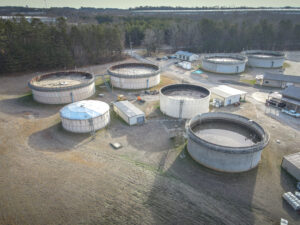
Maintaining public health in the U.S. requires a massive logistical effort. The ASCE reports that there are 2.2 million miles of piping buried beneath our feet to provide fresh water. This system is supported by over 16,000 specialized plants responsible for cleaning and recycling wastewater before it returns to the environment. Pineda emphasizes, “These projects are the reason you have clean tap water.” She continues, “Just think about your health, right? It’s preventing waterborne illnesses, ensuring you have safe tap water in your home.”
Pineda grew up farming with her father which led to her love for understanding systems and being outside. The graduate of the University of South Carolina Aiken studied Industrial Process Engineering. As a young professional, Pineda did not know what the next steps were for her career. She looked into planning new facilities or building hospitals, but when she realized she could not stand being inside all day, she switched gears. “I just applied,” she said. Pineda describes getting a call from a project lead, and she had no knowledge of the field that would soon become her career path. After seven years working in the water infrastructure sector, Pineda loves mechanical systems, working in a specialized industry, and making an impact in communities. “As challenging as the work is, it is equally as rewarding,” Pineda says. She has loved her role and the work she has achieved since starting with Reeves Young in 2023.
Her parents have a saying that Pineda has carried with her entire life: “¿Si alguien mas pudo hacerlo, yo también puedo?” — If someone else can do it, why not you? It’s a mindset that has shaped her confidence in the construction industry. When the pressure builds or doubt creeps in, she reminds herself of a simple truth: “We’re all people. At the end of the day, we’re just humans, and we are doing a job.”
Although her role has led to a long-term love for project management in water resource systems, Pineda hasn’t always felt this confident being a woman in a male-dominated industry. Her journey is similar to the experiences of many other women in the industry and reflects the broader shift taking place behind the scenes.
As the industry recognizes Women in Construction Week, female participation continues to rise, with women now representing approximately 12.4% of the construction workforce nationwide — a sign of meaningful progress and expanding opportunity. In Georgia, women make up 12.3% of the industry, ranking the state 10th nationally for female representation in construction (Jones, 2026). Some regions have female representation nearing 18% (Schoen, 2026). Meanwhile, states such as Vermont, Iowa, and South Dakota rank among those with the lowest percentages–averaging just below 10%– of women employed in the field (Jones, 2026).
For women considering a career in construction, Pineda offers advice she lives by daily: be comfortable being uncomfortable. “We’re already used to it,” she says. “As women, that’s part of our everyday life. And we are just as tough [as men] to be here.”

She emphasizes that confidence isn’t something you walk in with on day one — it’s something you build. “You’re going to build it over time. You just have to stick with it. It’s not easy. It’s not. But women are tough by nature. When someone says, ‘Oh, I can’t do this,’ I think, ‘No, I can do that and probably better.’”
For Pineda, resilience is already part of who women are. And she’s seen the industry evolve. “Men are starting to realize — ‘Hey, they can do the job just the same as we do.’ The more women we have out here, the more that confidence will grow. It comes with time. You just have to stick it out.”
For young women considering a future in the AEC industry, Pineda’s advice is simple: “Do it scared. More people are willing to open the door for you than to shut it.”
With an industry-wide labor shortage and more than $1 trillion in infrastructure projects underway, there has never been a more opportune time to enter the field. The demand is real, the work is meaningful, and the door is open.

Sources:
https://www.lumberfi.com/blog/female-construction-worker
https://www.asce.org/advocacy/priority-issues/water-infrastructure
https://constructioncoverage.com/research/cities-with-the-most-women-in-construction
https://www.conexpoconagg.com/news/the-history-of-women-in-construction